
The infrastructure behind AlgoBuilder’s AI trading automation
AlgoBuilder, one of Think Huge’s own brands, lets retail traders draw a strategy on a chart and get automated, tested code in return. Underneath, none of that compute sits on fixed servers waiting for work. It runs on the same Kubernetes-native infrastructure Think Huge builds for every partner.
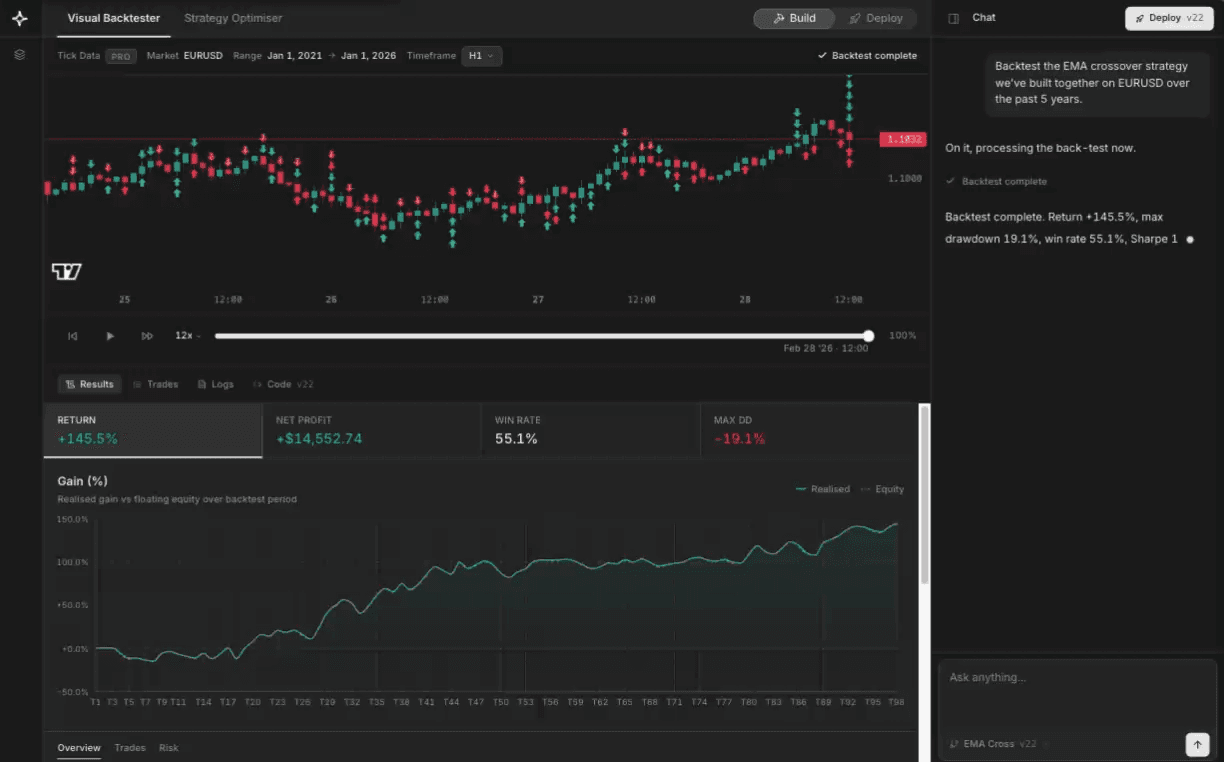
What AlgoBuilder does
AlgoBuilder takes a trader from a strategy idea to automated code, without the trader writing any of it by hand.
Draw your trade on the chart. AI sees exactly what you mean.
Mark up entries, exits, and rules directly on a chart. No coding required at this stage.
AI asks the right questions, then writes your strategy in code.
It reads your entry and exit from the chart, then asks the simple questions a chart can’t answer: trailing stops, break even, risk per trade, time of day. Your answers become clean Python, ready to test.
Watch how your strategy performs on historical market data.
The corrected strategy runs against tick data back to 2003, across 1,602 markets, showing the risk-adjusted returns it would have produced.
Run the Optimiser to unlock efficiencies in your strategy.
AlgoBuilder steps through each parameter in the strategy to find the strongest setup, while guarding against curve-fitting the result to historical data.
Launch your trading strategy into MetaTrader 5, easily.
A finished strategy goes live from the AlgoBuilder desktop app. It runs on your own Windows machine and sends every order directly to MetaTrader 5, whichever broker you use.
The infrastructure challenge underneath
Every stage above is a different compute problem.
Define runs an interactive session: the AI reads the marks off the chart, asks the trader the questions the chart cannot answer, and generates and validates Python against every answer as it arrives, so the code that comes back is the strategy the trader actually described.
Validation has to run that strategy against decades of tick data, across thousands of markets, and return results fast enough that the trader stays in the flow of building their strategy rather than waiting on a queue.
Optimisation is heavier again. Stepping through every parameter to find the strongest setup, without overfitting the result to history, can mean long-running compute jobs rather than a quick calculation.
None of this happens on a schedule. A trader might build one strategy a week, or ten in an afternoon. Fixed servers sized for the busiest hour sit idle the rest of the time. Servers sized for the average hour fall over on the busiest one.
How Think Huge powers AlgoBuilder’s compute
AlgoBuilder runs on Think Huge’s Kubernetes-native orchestration layer. Every stage, define, validate, and optimise, triggers a script that spins up its own Docker container to do the work, then tears it down once the job is done.
A Define session gets its own container for as long as the AI needs to generate and validate the code, no longer.
A backtest across thousands of markets runs in parallel, each market’s simulation in its own container, rather than queueing one after another.
A long-running optimisation sweep is scheduled, monitored, and restarted automatically if anything fails partway through, so a multi-hour job doesn’t need a human watching it.
Each customer’s strategy computes in its own isolated environment. Isolation is enforced at the infrastructure layer itself, not inside the container, so one customer’s job can’t see or touch another’s, however many are running at once.
None of this is provisioned as fixed capacity. AlgoBuilder doesn’t run, or pay for, a server farm sized for its busiest day. Kubernetes schedules containers to match demand as it arrives, and releases the compute the moment a job finishes.
AlgoBuilder joins Think Huge’s other consumer brands, FXVM, ForexVPS.net, and PingPlayers, running on the same infrastructure standard Think Huge sells to every partner. Nothing about this stack is a lighter, internal-only version.
This case study is built on the following infrastructure layers
AlgoBuilder’s compute runs on the orchestration layer described here:
AlgoBuilder also sits within Think Huge’s wider trading technology work:
Kubernetes-native orchestration for every compute stage: define, validate, and optimise
Isolated Docker containers per job, spun up on demand and torn down on completion
Parallel execution across markets and parameter sets, rather than one job queueing behind another
Automatic scheduling, monitoring, and restart for long-running optimisation jobs
Code currently generated in Python, with additional languages planned
Deployment expanding to support multiple platform providers
Trust and assurance
Runs on the same Kubernetes-native orchestration Think Huge builds for every partner
Not a lighter internal version.
Isolation enforced at the infrastructure layer
So one customer’s strategy can’t see or touch another’s.
Joins FXVM, ForexVPS.net, and PingPlayers as proof
Think Huge holds its own brands to the same infrastructure standard it sells externally.
24/7 operational support
From the team running the infrastructure, not a third party.